Workingmen's

Workingmen's

Wednesday, November 5, 2014

Arbitrary Deportation Frenzy


Vice News offers a few short videos regarding immigration trends in the U.S., but this segment in particular, entitled, “Immigrant America: The High Cost of Deporting Parents,” focuses on the gravity of extraditing the breadwinner of a family, begging the question: what role do the majority of immigrants play in our socio-economic welfare? Need we reconsider the process by which we systematically weed out and obliterate thousands of illegal immigrants on a daily basis?

In the twenty-five minute video, viewers are acquainted with the story of Ray Jesus, an illegal Guatemalan immigrant who came to the U.S. at a young age, and settled in Cedar City, Utah, where he met, married, and had five children with an American born woman. Shortly thereafter, Ray launched his own construction business, and the happy couple were able to maintain a comfortable, middle-class life in a respectable suburban neighborhood. Fast forward ten years, and Ray is accosted by immigration customs right at his doorstep; he is immediately plucked from his property, forced to leave all his belongings and his wife and children, before being ushered out of the country. Ray is sent back to his hometown in Guatemala, where he settles in a tiny mud-brick hut his parents had constructed from the money he sent them whilst living in America. The camera shows shots of Ray chopping wood, a task he must endure every morning to ensure food in the evening, and we later see him clinging to the sides of a large precipice with a pick-ax, scuffing away at the mountain-side for the meager wage of five dollars a day. Back at home, his wife is struggling to put food on the table, as she’s now forced to rely upon government assistance to survive.

When Ray first immigrated to America, he issued a court appeal. However, immigration court appeals can take years to process, allowing immigrants ample time to establish a life for themselves, as Ray succeeded in doing. Ten years down the line, when Ray had to update his license in accordance with a new state act, Utah discovered his old deportation order, and he was immediately prosecuted.

As quoted in the video, it costs around $12,500 to deport one person, and since Obama stepped into office in 2009, about 1,000 immigrants are deported daily, which amounts to about $25,000,000,000 of tax-payer money dedicated to funding immigrant deportation in the last five years.

And on what basis are we dishing out these compensatory funds? Ray was a hard-working citizen and a regular consumer, as are the majority of U.S. born citizens. The cost of Ray’s arrest, plus tax revenue from his business, plus all the government assistance his family had to rely on after his dismissal amounts to far more than $12,500 out of tax payers’ pockets—and for what arbitrary reasons? Instead of blind, widespread deportation of immigrants, many of which serve as the breadwinners of the family and contributors to our economic growth, shouldn’t there be some sort of evaluative process? We undermine the extent to which illegal immigrants feed and support our nation when we shovel billions of dollars towards their extradition. 

"Humans Only!:" Outer Space and Spacial Restriction in Alien Science fiction

In 2009, the film District 9 was released. The plot involved the arrival of a large ship of refugee aliens, referred to in the film derogatorily as "prawns," in Johannesburg, South Africa in 1988, and the aliens' immediate sequestering in District 9, a bleak shantytown. The plot was inspired by the events in District 6, Cape Town, during the Apartheid era, as well as various other forced relocations and segregations throughout the 20th century. The original short film that District 9 was based on, "Alive in Joburg," took interviews with South African citizens concerning their opinions on the arrival of Zimbabwean refugees and placed it in the film in the context of the arrival of aliens. Similar interviews were used in the first teaser previews for District 9.
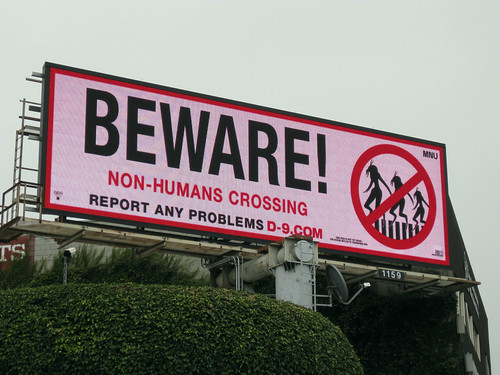
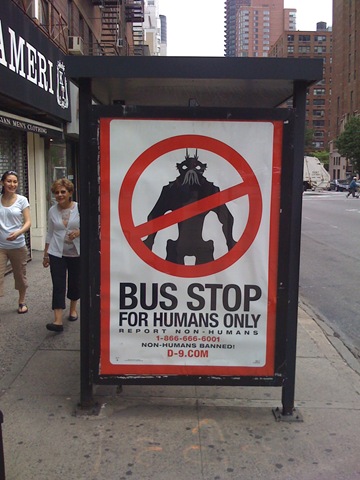
There are many interesting points about District 9 to be critiqued and expanded on as it relates to race, labor, and migration, but what I found was most interesting  was its viral, immersive marketing campaign, aptly named "Humans Only."
The 2010 British film "Monsters," whose plot was about giant cephalopodic aliens landing in Mexico and prompting the quarantine of the northern half of Mexico and the erection of a massive wall across the United States' southern border would utilize a similar "world building" ad campaign focusing on the restriction of the "quarantine zone" of Northern Mexico. 
Both films feature human panic, prejudice, and overreaction in the face of the arrival of an "other," and both ad campaigns utilize the idea of the restriction and illegalization of spaces as adaptive to the presence of the "other." Why is this?
Restriction of space and forced relocation has long been a means of controlling and criminalizing the very presence of individuals deemed 'undesirable.' When one cannot outright name an individual as 'illegal' because that individual is a vital part of a complex system to exploit them, one restricts the spaces where that individual is able to go in order to maintain that the individual remains in their place of exploitation and marginalization.

Paper Beats Paper: "Paper Sons" and the Chinese Exclusion Act of 1882


Good evening yall! I'll be writing this blog post about the "Paper Sons" and their struggle to come to the U.S. I'll also be touching on some of the acts and legal procedures that occurred.

"Paper Son" was a term coined for young Chinese males trying to beat the system by buying papers. These papers were established by Chinese-American citizens who could go back and forth. Once they go to China, they would pick out a bunch of potential wives and children so they'd be able to come to the U.S. The boys that were ready would try to come to the U.S., most being only sons by "paper", hence the term.

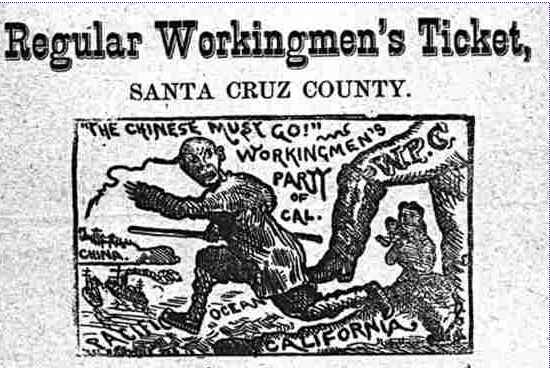
We know from class that the Chinese were welcomed throughout the middle part of the century. With the abundance of gold, there is not much record of them not being wanted around. However, when gold truly became scarce, the sentiments changed. They did not cost a lot for labor which drove prices down, angering a lot of white labor workers. The Chinese were an integral part to the history such as building the transcontinental railroads.

The Chinese Exclusion Act of 1882 was the only law in American History to deny citizenship based on a specific nationality. Before this law, U.S. was open to most immigrants with varying jobs and skills. Yellow peril combined with a recession led to creation and acceptance of this act which was the beginning of the Immigration and Naturalization Service. The loophole however was that a son or daughter of a citizen was also granted entry regardless of nationality.

In order to truly grasp how laws where created at the time, I'm going to bring it back a few years. Christine mentioned the court case People v. Hall which featured a Chinese witness who witnessed a white man murdering another Chinese individual. The court essentially deemed the testimony admissible which demonstrated that anyone who isn't a citizen can get away with murder.

Coming to the U.S. because of the opportunities were extremely difficult for the Paper Sons. Memorizing key information of their proposed family was only a small step in maintaining one's life in a time with much negative sentiments towards their ethnicity. It was only till WWII when the many of the Chinese Exclusion acts and laws were overturned, only to have the shifting negativity move towards the Japanese.

As you can see, in the game of immigration rock, paper, scissors, the U.S. may attempt to the different laws on paper, but it takes a lot of courage to beat the system as use paper against them.

Thank you for reading yall. :)


Tuesday, November 4, 2014

Reconsideration of the Term Illegal

This image challenges the notion of illegal immigration and suggests a double standard in some modern perceptions of what an illegal immigrant is.  We often consider white European settlers as just immigrants while today Latino immigrants are associated with being illegal.  But when European immigrants came to North America, there was no legal legislation that allowed them into the country.  They established their own set of rules and eventually those rules became standard.  Illegal immigration has now developed into creating a sentiment of fear against not all immigrants but mainly Latino immigrants with the overarching stereotype that they are here without official paper work. But what does it mean to be consider "illegal"?  How does your identity become narrowly defined as an "illegal" person by the constraints of a society you have no voice in?  As modern American thought concludes, Latinos are illegal but this definition can extend further to cover races who are underrepresented.

Consider the Mammy figure and the social undermining of black personhood, which in terms, contributed to the upward battle blacks fought for freedom and civil rights.  Although African Americans are not often associated with being "illegal", can a person be "legal" if their rights are taken away and they have no ability to participate in the legal system?  If the legal system is systematically working in opposition to a race's success and prosperity, can the person of that race be considered fully legal?  The legality of a person is focused heavily on the issue of immigration but legality is your full status as a citizen.  It is not just a matter of residency but a matter of rights and being a respected member of society whose voice is able to be heard and whose opinion is taken into account.  Images of the Zoon Coon, mammy, minstrel performances, etc., dehumanize African Americans, taking illegality to a new extreme of not having the right to participate in decisions and events that effect our legal system.   

Does the “X” in X-Files stand for “xenophobia?”


Almost every single police procedural show on primetime television will have an episode dedicated to the linked topics of illegality and immigration. Like Law and Order: SVU’s “Debt,” The X-Files’ “Teliko” and “El Mundo Gira” also incorporate these themes. However, while Law and Order: SVU attempts to give a fair if not detached portrayal of the issues that undocumented sex workers face, the X-Files uses the figure of the migrant laborer or the immigrant as the “Monster of the Week,” dehumanizing and othering these figures and the people who are associated with them.

“El Mundo Gira” (Season 4, Episode 11) begins in a migrant labor camp near Fresno, California, where an undocumented laborer has been found dead. Mulder and Scully are called in to investigate the death, as the woman’s face has been eaten away. The culprit is a fungal infection brought into the country from Mexico by another male undocumented laborer, who is quickly infecting the rest of the people in the camp. Mulder and Scully race to apprehend and give the man an antidote to the fungus, but he crosses the border back into Mexico, still infected. In “Teliko,” (Season 4, Episode 3) an immigrant man named Samuel Aboah from Burkina Faso tries to obtain his citizenship papers while living with an expired tourist visa so he can get a job in New York. It is revealed that he is the “last of an endangered tribe” that lacks a pituitary gland and must kill and eat other people’s pituitary glands to survive.1 Aboah murders several people for their pituitary glands while trying to obtain citizenship in America, eventually being shot in a standoff with Scully. As she types up the report, she wonders if a cure for Aboah’s condition can be found, but resigns herself to the xenophobia that would prevent such a cure from being discovered.

In both of these episodes, the figure of the illegal/undocumented immigrant has brought with them a form of life-threatening destruction to America. The fact that each “antagonist” or “Monster of the Week” is made to be an “illegal” person in the United States speaks to the casual xenophobia that pervades these two episodes. Combine this with the fact that each “monster” (fungus and a hunger for pituitary glands, respectively) has a foreign origin, and suddenly The X-Files has built a case against illegal immigration. Unfortunately, because The X-Files never made itself a hard-hitting exposé of any criminal underworld a la Law and Order: SVU, The X-Files hides behind its status as a science fiction show to avoid addressing its racist and xenophobic tendencies.

Spaceships, "Illegals", and Guns

    Within popular culture, aliens are depicted as slimy intimidating beings: they are the epitome of what it means to be "the other". It's odd we use the terminology of "illegal alien" to describe immigrants in the U.S. "Illegal alien" is a menacing word in itself. Illegal is defined as "contrary to or forbidden by law, especially criminal law"; while alien is defined as "belonging to a foreign country or nation". An individual entering our country unlawfully is considered "criminal law" if one synthesizes the definitions the internet provided by the terms above. I think it's important to explore the role that an "illegal" performs, the policies we vote in favor of, and the power the individuals have that enforce those laws-the patrol itself.

    As we have discussed in class, immigrant labor is wanted but the person is unwelcome. This transforms itself into a paradox. The image above portrays the U.S. as having all of the answers and resources, while Mexico has nothing except for a map to the U.S. It is as if the Americans are the victims with a multitude of resources when, all of a sudden, unwanted people scurry under the border fence. The question is: what makes this border so threatening juxtaposed to other borders? The Canadian border, isn't as patrolled as the Mexican border; and people can freely move from country to country in Europe. So what makes this border in particular so special? By calling somebody an "illegal" it has the power of stripping somebody of their humanity. They are seen as an "other". This "othering" is dangerous, for it allows violence to brew. This has been seen throughout our history: slavery in the south, the Chinese in indentured servitude, the Irish working the railroads, etc. These different groups have been attacked, violated, and discriminated against because they were cast as "others". When one isn't seen as a person, society doesn't feel the need to treat them as a human being. It's as if our society would like the dirty jobs magically done without the person who is doing the job. Yet I hear Americans constantly say, "those Mexicans are taking our jobs". In Watsonville, however, the fields are filled with Mexican individuals picking the produce that everyone else is to enjoy. They are exposed to the sun and pesticides and verbal violence that comes with a job. Mexicans are "the strangers" within our society. Within store-fronts such as Home Depot they are susceptible to the manipulation that comes with hard labor by whomever scouts them for work at their household.

     This is similar to the violence that the Chinese faced during indentured servitude. The law gave infinite power to whites, the Chinese were hardly accounted for. In society passing laws over the "illegals" and by passing stricter border patrol (cosigning guards to be more violent) the violent system will continue to flow more forcefully like a river. It is ironic that those who vote in favor of tougher border patrol enforcement are concerned for job security; for it costs tax payers more money for these detention centers, finger-print technology, the increased staff for the border, etc. Violence is written into the law and for a very specific group in mind: the Mexican immigrant.

    I also feel that it is important to take note of the lack of punishment that U.S. Border Patrol Agents face when they are guilty of perpetrating mistreatment. Of the complaints received regarding Border Patrol Agents, few are reviewed let alone resolved. The Portland Press Harold explored this topic and found that there were "...809 complaints filed in the three years from January 2009 to January 2012. But of those, only 485 had been investigated and resolved". These astounding numbers speak to where our priorities lie. It isn't necessarily with justice, but rather seclusion. These immigrants are denied the rights that we have as citizens. When they are mistreated, their case goes in a box unlikely to ever be looked upon. In fact, "...The average number of days between the date a complaint was filed and the last record date provided in the data was 389 days" http://www.pressherald.com/2014/05/07/u_s__border_patrol_agents_rarely_face_punishment__report_reveals_/. 

    By viewing human beings as others we abandon the very thing that makes us human: compassion. Instead of viewing the role we have played in Mexico's economic system, we choose to act as if they aren't humans. As if they are the villains that are inclined to slip under the border with the sole purpose of stealing jobs. This simple thinking is dangerous, for it allows individuals to justify enacting inhumane policies, and turning the other cheek when the individuals enforcing these policies act violently.

Monday, November 3, 2014

Temporal Dysphoria: Race and the Time Traveler

In Kindred, a black woman named Dana falls through time to the antebellum south, repeatedly saving the life of a plantation heir named Rufus, who later turns out to father Dana's direct ancestor. In the midst of her adventures, Dana feels a constant and anxiety, a desire to return to her own time coupled with the need to find at least temporary safety and stability in the past as well as keeping Rufus alive. Dana's experiences are traumatic, and linger with her and create a sense of unease and displacement even when she is in her own time. Dana's primary means of protecting herself in the past is making herself indispensable to Rufus. Reading Kindred got me wondering, how does speculative fiction, particularly time-traveling speculative fiction operate in terms of recognizing the advances made, and the progress that has yet to be made in terms of race and labor? I decided to look at a recent piece of media that concerns a black time-traveling woman.

This is Martha Jones. Second companion to the Tenth Doctor in the long-running  British sci-fi series, Doctor Who. Martha is a brilliant and driven young medical student. With the Doctor, she travels through time and space. The writers of Doctor Who have briefly explored the social implications of Martha's role as a black time traveler in regards to some episodes where she and the Doctor traveled to London in 1599 and Edwardian England, though it arguably downplays and perhaps even downright ignores the implications and violence of English colonialism. While Martha's role as a time traveling black woman doesn't highlight the traumas of racism and colonialism like Dana's narrative does, the role she inhabits in the narrative does have a dysphoria that also leads to Martha's great discomfort and eventual split from the doctor.
To make a very very very long Doctor Who narrative short, the Doctor was in love with his previous companion, Rose, but due to some events he can never see Rose again. Eventually Martha joins up with him but their relationship, (While still bearing a great deal of affection, whimsy, and adventure as is the general tone maintained for Tennant's Doctor Who) has several strained undertones. The Doctor is clearly not over Rose, Martha unfortunately develops feelings for an already emotionally-unavailable Doctor and raises concerns that she might be a rebound for the Doctor, which the Doctor never actually fully addresses. In the season finale, Martha ends up saving the world by going all over the earth over the course of a year while the Doctor is captured and incapacitated. Martha risks life and limb when everything seems lost to keep hope alive and save everyone, though she acknowledges how unhealthy her relationship with the doctor has become and leaves. Martha is the first official black companion to the Doctor (if you don't count Mickey Smith, who was a secondary companion when Rose was the "main" companion), but Martha is essentially stuck inhabiting a narrative where the Doctor is by and large ignorant of her feelings and concerns unless it's along the lines of, "Doctor, aliens are attacking and we're in immediate physical danger!" While her time-traveling narrative doesn't acknowledge the dysphoria of historicized racial violence, Martha is still stuck with a dysphoric narrative in being stuck with a Doctor who (in most circumstances is totally elated to share the universe with his companions and forge deep friendships with those companions) is still totally wrapped up in his previous (white) companion. Martha does go on to become a very strong character, but a lot of this development happens offscreen, only having Martha turn up at various specials and in the spin-off Torchwood on occasion. In short, Martha was a great companion who was stuck with the Doctor at the wrong time.
I'd like to further discuss race and labor in regards to science fiction and fantasy (And to be honest I'm no expert on Doctor Who----so if anyone who has more experience watching the show would like to discuss this further I'm up for it! But I still feel like Martha got the narrative short end of the stick) and I'l probably explore illegality in science and fantasy fiction next. If you guys have any suggestions for anything I should discuss in my next blog post or other questions or discussion points, feel free to comment!